

Interview with Dr. Esli Spahiu, Manager at AI Experience Centre (powered by LHoFT)

Dr. Esli Spahiu
AI Experience Centre Manager
LHoFT
Artificial Intelligence is rapidly reshaping the financial services industry, creating new opportunities for innovation while raising important questions about governance, trust and practical implementation. At the heart of this transformation, Luxembourg is positioning itself as a leading hub for responsible AI adoption through initiatives that bring together financial institutions, technology providers, startups and regulators.
In this edition of SFF Magazine, we speak with Dr. Esli Spahiu, Manager of the AI Experience Centre at the Luxembourg House of Financial Technology (LHoFT). With a background in digital transformation and innovation across both the public and private sectors, and following the completion of his PhD, Esli has dedicated his career to helping organisations harness emerging technologies to improve performance and create long-term value.
In this interview, she shares the vision behind the newly launched AI Experience Centre, explains why making AI tangible and experiential is essential for the financial sector, and reflects on the opportunities and challenges that lie ahead. From compliance and fund management to AI literacy and ecosystem collaboration, his insights offer a compelling perspective on how Luxembourg can drive the next generation of financial innovation.

The AI Experience Centre was officially launched recently. What was the original vision behind creating this initiative in Luxembourg?
The original vision was to create a concrete physical space dedicated to AI in Finance in Luxembourg. Not another place where AI is discussed at a high level, but a space where it can actually be experienced. The goal is to position Luxembourg as a strong and responsible AI ecosystem for financial services, while keeping a clear focus on real use cases and practical impact.
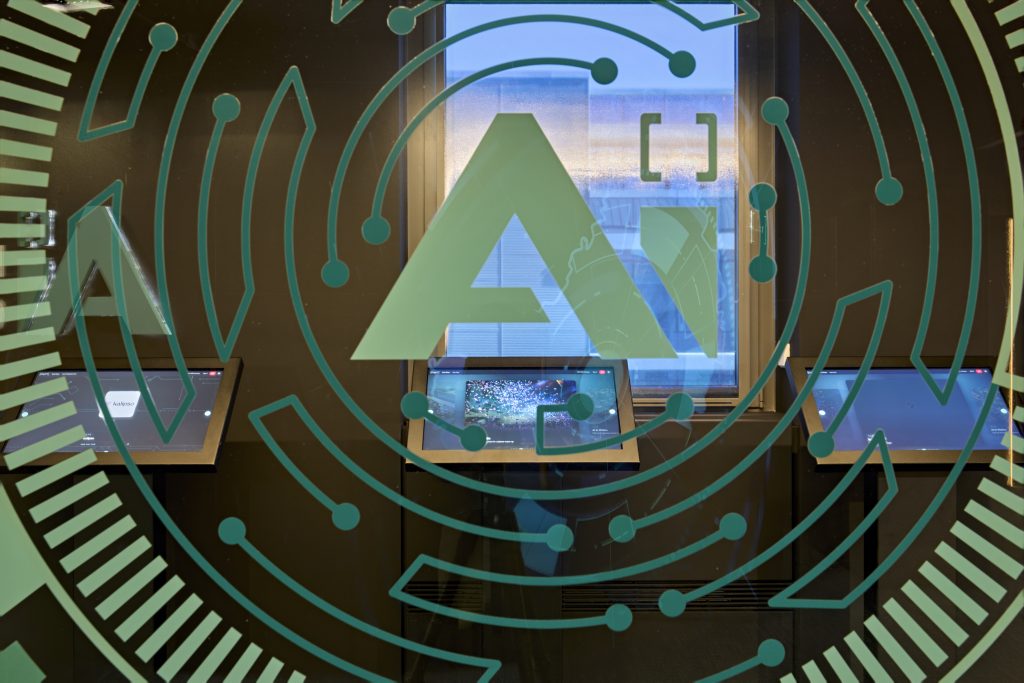
Currently, the Centre brings together more than 20 live demonstrations from both local startups in our ecosystem, broader ecosystem in Luxembourg and international providers. Each demonstration has been selected to address some of the real-world challenges facing financial institutions today, including fund management, portfolio management, risk management, compliance, and regulatory reporting.
The Centre also aims at playing an important educational role by hosting training programs delivered in partnership with our supporting organizations, helping both current professionals and the next generation of talent develop the skills needed to thrive in an AI-driven financial sector.
“The goal is to position Luxembourg as a strong and responsible AI ecosystem for financial services, while keeping a clear focus on real use cases and practical impact.”
One of the most distinctive aspects of the Centre is its highly interactive and experiential approach to AI. Why was it important for you to make AI “tangible” and hands-on, especially for financial sector professionals?
Because with something as fast-moving as AI, understanding really comes through experience. In our early conversations with the industry, we saw that the main barrier was often not distrust, but a lack of practical understanding of the use cases and the value they can create in a real business context. AI is evolving so quickly that it can feel abstract or overwhelming, so we wanted to give visitors the chance to see it in acion. The Centre allows organizations to bring their teams, partners, and even clients to explore tailored demos, interact with live platforms, and see outputs in real time, which we hope will make AI feel far more familiar and useful. And we believe that changes the conversation completely as it becomes much easier to understand where AI adds value and where it does not.
How do you see the AI Experience Centre contributing to stronger collaboration and innovation across Luxembourg’s financial community?
I believe the Centre’s contribution starts with both its setup and its content. The experience has been deliberately designed around eight immersive zones covering key areas such as compliance, wealth management, ESG and co-innovation. This allows visitors to focus on the topics that are most relevant to their own organization while also gaining a broader understanding of how AI is transforming the financial sector as a whole.
By bringing together financial institutions, startups, technology providers and regulators in one physical space, it creates opportunities for focused conversations, exchange of ideas, and the possibility to identify areas where collaboration can create greater value when working together. Through live demonstrations and workshops the Centre provides a dedicated environment where participants can learn or be inspired from each other’s experiences. Eventually, in a market like Luxembourg, where the financial ecosystem is highly interconnected, this type of platform can play an important role in strengthening the innovation community and ultimately drive the next generation of innovation in the country’s financial sector.
“By bringing together financial institutions, startups, technology providers and regulators in one physical space, it creates opportunities for focused conversations, exchange of ideas, and the possibility to identify areas where collaboration can create greater value when working together.”
From your perspective, what are the biggest misconceptions or fears that financial institutions still have about AI today?
One of the biggest misconceptions is that AI means losing control, especially around data or decision-making. Another common fear is that AI will replace people, when in reality most useful financial AI systems still depend on human validation and review. There are also concerns around data quality and whether organizations can really trust the outputs.
These are important considerations, particularly in a highly regulated sector like finance. However, AI is not a substitute for human judgment and accountability. Institutions remain fully responsible for their decisions, which is why the most effective approach for now is to use AI to support and strengthen human expertise rather than replace it.
Which areas of financial services do you believe are currently the most promising for meaningful AI transformation?
So far, fund management and compliance stand out as the two most promising areas, and we have also seen that reflected in the strong interest from visitors. In fund management, AI is already proving useful for portfolio analysis, reporting, and client communication. This is especially relevant in Luxembourg, given its central role in the investment fund industry.
Compliance is another area where AI can deliver meaningful impact. We are already seeing a strong focus on the development of AI tools for KYC checks, AML monitoring, regulatory tracking, and policy analysis. These are areas under increasing pressure due to growing complexity and documentation requirements, particularly in Europe, where regulatory standards are especially demanding.
“In fund management, AI is already proving useful for portfolio analysis, reporting, and client communication. This is especially relevant in Luxembourg, given its central role in the investment fund industry.”
Finally, the financial industry is entering a period where AI literacy may become essential for every organisation. If you had one message for financial institutions in Luxembourg that are still hesitating about AI adoption, what would it be?
My message would be to don’t decide on AI from the headlines alone, instead come experience it in action. At the AI Experience Centre here in Luxembourg, you can see what AI really does, ask the difficult questions, and test whether it is relevant to your business in a practical way. And if it turns out AI is not the answer for your challenge, that is still useful, at least we will have helped you figure that out faster.






Search posts by topic
Advisory (7)
AI (6)
Alternative Investment (25)
Alternative investments (3)
AML (1)
Art (1)
Asset Management (30)
Banking (17)
Capital Markets (1)
Compliance (1)
Crypto-assets (3)
custody services (1)
depositary services (1)
Digital Assets (4)
Digital banking (7)
Diversity (9)
EU (6)
Family Businesses (4)
Family Offices (2)
Fintech (10)
Fund distribution (31)
Governance (12)
HR (9)
ICT (1)
Independent Director (9)
Insurance (3)
Internationalization (1)
LATAM (9)
Legal (12)
Private Equity (5)
Real Estate (2)
Regulación (1)
Regulation (7)
Reinsurance (2)
RRHH (1)
Stock Market (1)
Sustainable Finance (23)
Tax (19)
Technology (6)
Transfer Pricing (3)
Trends (29)
Unit-linked life insurance (6)
Wealth Management (13)